
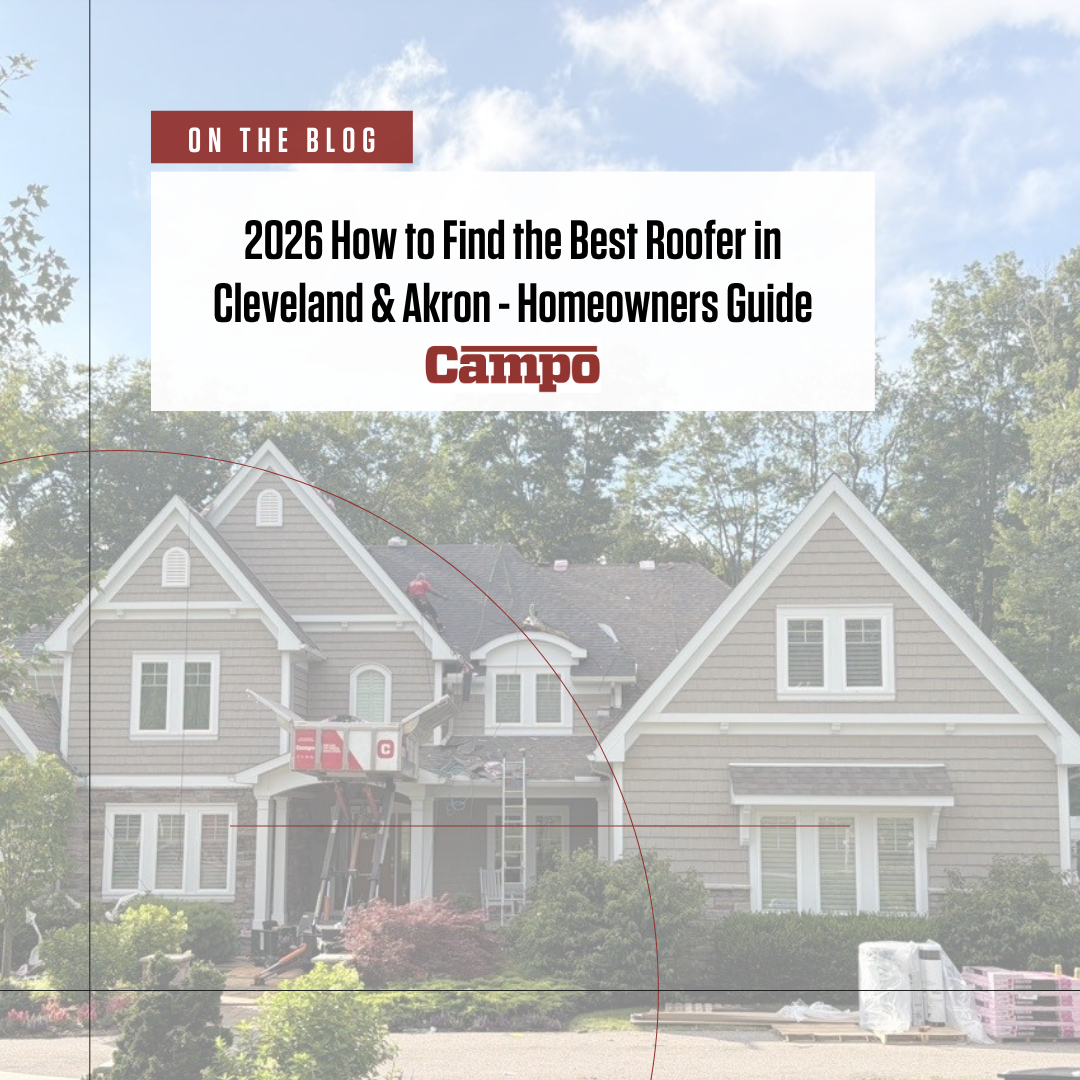
Here’s what nobody tells you about hiring a roofer: the bad ones and the great ones charge about the same, and they look identical until the first hard rain. With dozens of roofing contractors serving Cleveland and Akron, the hard part isn’t finding one—it’s knowing which one won’t leave you with a leak and a disconnected phone number two winters from now.
Campo Roof has served Northeast Ohio families for almost 50 years, and we’ve seen what happens when homeowners rush this decision. We’ve also seen how the right choice leads to roofs that last for decades without a single leak. This guide walks you through every step of choosing among the roofing contractors near you—from verifying credentials to understanding warranty options—so you can hire with confidence.
Cleveland and Akron homeowners face roofing challenges many parts of the country never see. Harsh winters bring heavy snow loads, ice damming, and 40–60 freeze-thaw cycles a year that stress roofing materials. Summer storms arrive suddenly with high winds and hail.
A contractor who understands these regional conditions will choose the right materials and installation methods. They’ll know ice-and-water-shield underlayment is essential along the eaves in our climate. They’ll recognize when attic ventilation problems are the real cause of ice dams. And they’ll understand local building codes—Cleveland requires general contractor registration, and individual suburbs run their own inspection processes. A contractor unfamiliar with these requirements can leave you with code violations or delayed timelines.
That’s why “residential roofing” done well here isn’t just about nailing down shingles. It’s about knowing how a roof has to perform through an Ohio winter.
Before you let anyone on your roof, verify these essentials. Missing any one of them should be an immediate red flag.
Your contractor must carry both liability insurance and workers’ compensation coverage. Liability insurance protects your property if something goes wrong. Workers’ comp covers injuries to crew members working on your home—which, without it, can become your liability.
Ask for current certificates of insurance, and if you have any doubt, call the insurance company directly to confirm. If a contractor can’t produce proof of insurance, don’t hire them.
Ohio doesn’t require a statewide roofing license, but many municipalities do require registration. Cleveland requires general contractor registration with specific insurance and experience standards, and Akron and surrounding suburbs have their own rules. A legitimate contractor will know exactly which permits your project needs, handle the applications, and schedule the required inspections.
Leading manufacturers like GAF, CertainTeed, and Owens Corning run contractor certification programs that require training, insurance, and quality standards.
GAF’s program, in particular, has multiple tiers, and the differences matter:
Credentials tell you a contractor meets minimum standards. Reputation tells you how they actually treat homeowners on real projects.
Look across multiple platforms—Google, Facebook, the Better Business Bureau (BBB), and Angi (formerly Angie’s List). Pay attention to patterns rather than individual reviews. Does the contractor respond professionally to complaints? Do reviewers mention specific, verifiable details? Be wary of profiles with nothing but five-star ratings, no substance, and no photos; authentic local roofer reviews usually include some constructive feedback alongside the praise.
The BBB is also useful for confirming how long a business has been accredited and whether complaints were resolved. Angi and Google reviews tend to capture the day-to-day homeowner experience.
Request references from projects completed in your area within the past two years. A contractor working consistently across Cleveland and Akron should have no trouble providing several. When you call, ask specifically: Did the crew show up on time? How did they handle surprises? Was the final invoice consistent with the estimate? Would you hire them again?
How long has the contractor been in business? A company serving your community for decades has a track record you can investigate—and is far more likely to still be around if you need warranty service years from now. Confirm they have a real physical address, not just a P.O. box. Campo Roof has been rooted in Twinsburg and serving Northeast Ohio since 1978.
Never sign a roofing contract without a detailed written estimate. A thorough estimate protects both sides by setting clear expectations.
Materials specification. The estimate should name the exact products: shingle manufacturer, product line, and color, plus underlayment type, ice-and-water-shield coverage, flashing materials, and ventilation components. Generic descriptions like “30-year shingles” aren’t enough—you need to know exactly what’s going on your roof to verify quality and warranty coverage.
Scope of work. It must define what will be done: complete tear-off or install-over, which areas are included, and whether valleys, ridges, and pipe boots are being replaced. If it isn’t in writing, assume it isn’t included.
Project timeline. Expect start and completion dates. Most straightforward roof replacements in Northeast Ohio take one to three days of actual work, weather permitting. The estimate should also address what happens if rain causes a delay and how your home is protected overnight on multi-day jobs.
Payment terms. Understand the deposit and balance schedule. Industry standard is a deposit of roughly 10–30%, with the balance due after you’ve inspected completed work. Be cautious of anyone demanding full payment upfront.
Warranty information. The estimate should spell out both the manufacturer warranty (covering material defects) and the workmanship warranty (covering installation quality). As a GAF 3-Star President’s Club contractor, Campo Roof can pair GAF’s manufacturer coverage with premium workmanship warranties—and we back our own work with a 25-year leak-free guarantee on qualifying installations. Together, that means many homeowners are protected on both materials and labor for decades.
The inspection process reveals a lot about a contractor’s professionalism. Notice how thoroughly they examine your roof and how clearly they explain what they find.
A quality inspection goes well beyond eyeballing shingles from the driveway. It should cover shingle condition (granule loss, curling, cracking, missing shingles), flashing around chimneys, vents, and skylights, valleys and other high-water-flow areas, vent boots and pipe penetrations, gutters, soffit and fascia, and attic conditions including insulation, ventilation, and any signs of moisture.
Campo Roof offers a free 25-point inspection covering both interior and exterior elements, and we document our findings with photos so you can see exactly what we see.
An honest contractor will also tell you when a repair makes more sense than a replacement. Age matters—most asphalt shingle roofs last 20–30 years—but condition matters more. A few missing shingles or a small area of damaged flashing can often be repaired affordably, while widespread granule loss, multiple active leaks, or deck damage usually points to replacement. Be skeptical of anyone recommending full replacement without clearly explaining why repairs won’t solve the problem. Reliable roof repair services start with an honest diagnosis. Get an inspection checklist here.
Prepare questions before you meet. The answers—and how confidently they’re given—tell you a lot.
Experience and qualifications: How long have you been in business in this area? Can you show proof of insurance and any required registration? What manufacturer certifications do you hold? Do you use your own crews or subcontractors? Who supervises the work on my roof?
The project: What products do you recommend for my roof, and why? Will you completely remove the existing roof? How will you protect my landscaping and property? What’s your plan if weather delays the job? How do you handle debris and cleanup?
Warranties and guarantees: What manufacturer warranties come with these products? Do you offer a workmanship warranty, and for how long? What’s covered and what’s excluded? How do I file a claim later?
The roofing industry attracts some bad actors. Knowing the warning signs protects you.
Storm chasers. After severe weather, unfamiliar contractors may go door to door offering “free inspections.” Many travel from area to area chasing storm paths, do substandard work, and disappear before problems surface. The BBB warns that storm chasers often manufacture urgency—claiming damage is worse than it is or pressuring you to sign immediately. Always confirm an established local presence before signing anything. Looking for storm damage repair?
Pressure tactics and too-good offers. A legitimate contractor gives you time to get multiple estimates and decide. Anyone insisting you “sign today or lose the price” isn’t acting in your interest. Be equally cautious of bids dramatically lower than the rest—those often mean cut corners, skipped prep, or surprise charges later.
Incomplete documentation. Reputable contractors put everything in writing. If a contractor is reluctant to commit promises to the contract, or the contract is vague on materials and scope, treat it as a warning. Your contract should match your estimate in every detail—never rely on verbal assurances.
National contractors and traveling crews may have experience, but they often lack familiarity with Northeast Ohio conditions.
Regional climate. Our winters demand specific techniques. Ice-and-water-shield underlayment should extend well past the exterior wall line, and proper attic ventilation prevents the warm air that melts snow and forms ice dams at the eaves. A contractor who doesn’t know this may install a roof that looks fine until the first hard winter.
Building code knowledge. Cleveland, Akron, and surrounding communities each have their own permitting and inspection requirements. Skipped permits or failed inspections can create problems when you sell, since title searches may reveal unpermitted work.
Accessible warranty service. If you need warranty work five or ten years out, a local contractor with an established presence is still here. Crews that traveled in for a project are often impossible to find later.
Your contractor should recommend materials suited to our climate and your roof’s design.
Asphalt shingles. Most Northeast Ohio homes use asphalt shingles, and modern architectural shingles offer durability, curb appeal, and color range. Pay attention to wind rating and impact resistance—Class 4 impact-rated shingles stand up best to our hail and can even earn insurance discounts.
Metal roofing. Standing-seam metal sheds snow and ice effectively and reflects summer heat. It costs more upfront than asphalt but can last 50 years or more with minimal maintenance.
Underlayment and components. What’s beneath the shingles matters as much as the shingles. Quality synthetic underlayment resists moisture better than felt, ice-and-water-shield membrane guards against ice-dam backup, and properly installed flashing at valleys, penetrations, and wall intersections is one of the most common places cheap roofs fail.
Get estimates from at least three contractors so you understand fair pricing and can compare approaches.
Compare equivalent proposals. Confirm each estimate covers the same scope—one may include new gutters or complete tear-off while another doesn’t. Ask contractors to spec the same product lines where possible, so you’re comparing service and installation quality rather than different materials.
Consider value, not just price. The lowest bid isn’t always the best value. Weigh warranty coverage, experience, material quality, and reputation. A contractor who charges a bit more but offers substantially stronger warranty coverage and a proven local track record often delivers better long-term value.
Trust your instincts. How did each contractor communicate? Did they answer thoroughly and seem genuinely interested in solving your problem? You may rely on this company for warranty service for years—choose someone you’re comfortable working with.
How do I know if a roofing contractor is properly licensed in Ohio? Ohio doesn’t issue statewide roofing licenses, but cities like Cleveland require contractor registration. Ask for the registration number and verify it with your local building department. Campo Roof maintains the required registrations for the Cleveland and Akron areas.
What warranties should I expect from a Cleveland roofing contractor? You should receive both a manufacturer warranty on materials and a workmanship warranty from your contractor. As a GAF 3-Star President’s Club contractor, Campo Roof can offer GAF’s premium warranty options—including workmanship coverage well beyond what a standard contractor warranty provides—and we stand behind our installations with a 25-year leak-free guarantee.
How long does a typical roof replacement take in Northeast Ohio? Most residential replacements take one to three days of work, depending on size and complexity. Weather can extend the timeline, especially in our variable spring and fall.
How can I verify a contractor’s GAF certification? Use GAF’s contractor search tool at gaf.com and enter your zip code to see certified contractors near you, along with their certification level. GAF’s top tiers require ongoing training, proper insurance, and a strong customer-service record.
How often should I have my roof inspected? An annual inspection helps catch small problems before they become major repairs, and you should also inspect after severe storms. Campo Roof offers a free 25-point inspection, making it easy to stay ahead of issues.
Ready to get started? Book an inspection today!
Looking to start a home exterior project? Let us know and start the conversation